
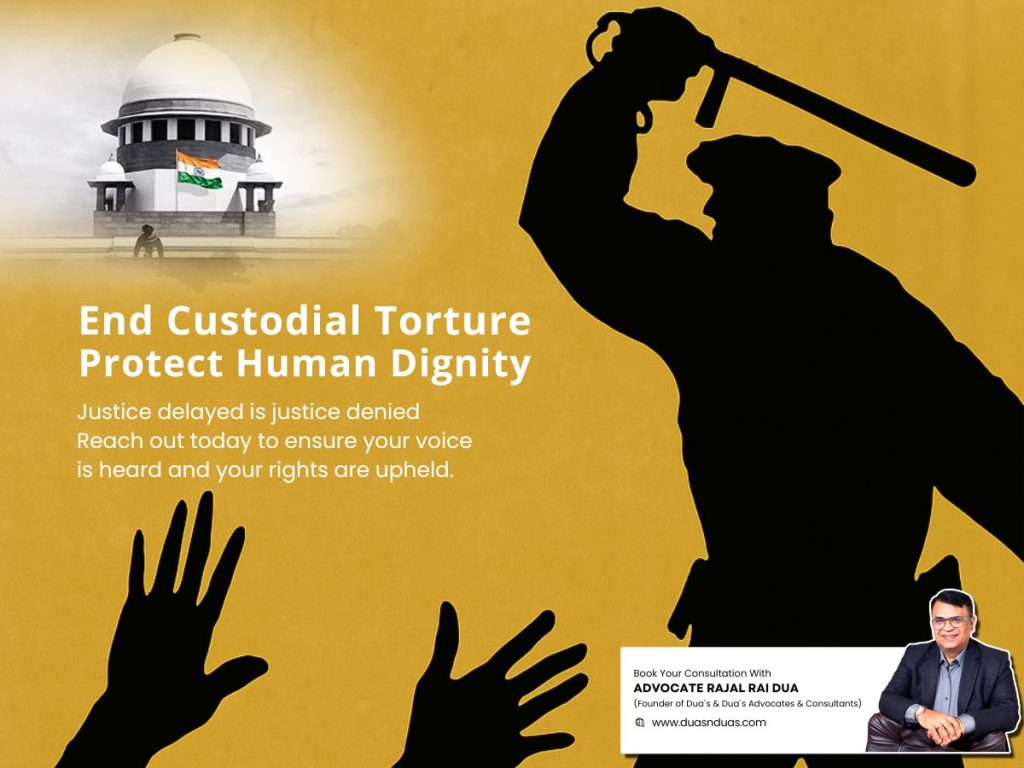
Upholding Human Dignity in Police Custody
Custodial deaths represent one of the gravest violations of human rights in a democratic society. In India, despite constitutional protections and legal safeguards, deaths in police or judicial custody continue to be reported, raising deep concerns over the misuse of authority. The Supreme Court of India, through various landmark judgments and directives, has laid down comprehensive guidelines to prevent custodial violence and ensure accountability.
Delhi-based legal expert Advocate Rajal Rai Dua, a leading Supreme Court lawyer and head of Dua’s & Dua’s Advocates and Consultants, weighs in on the legal framework, recent developments and the way forward for justice and reform.
A Legal and Human Rights Crisis
Custodial death refers to the demise of a person while in the custody of the police, prison authorities or any law enforcement agency. Such deaths may occur due to:
- Physical torture or assault
- Negligence in providing medical care
- Unlawful detention and inhumane conditions
- Psychological abuse leading to suicide
The National Human Rights Commission (NHRC) of India has consistently reported alarming numbers of custodial deaths each year. Despite constitutional rights under Article 21 (Right to Life) and Article 22 (Protection against arbitrary arrest and detention), victims of custodial violence often do not receive timely justice due to lack of accountability, cover-ups, and delayed investigations
Landmark Supreme Court Judgments on Custodial Violence
Over the years, the Supreme Court of India has delivered several crucial judgments aimed at curbing custodial deaths and safeguarding the rights of detainees. Some of the most notable include:
1. DK Basu v. State of West Bengal (1997)
This landmark judgment introduced crucial procedural safeguards to protect individuals in custody. The Court issued a set of 11 guidelines, including:
- Mandatory arrest memos with time and date
- Informing a relative or friend of the detainee
- Medical examination every 48 hours
- Production before a magistrate within 24 hours
- Police officers must wear name tags for identification
These guidelines were meant to be followed strictly and treated as enforceable under Article 21.
2. Joginder Kumar v. State of UP (1994)
The Court emphasized that arrests should not be made arbitrarily. It held that an arrest must be justified by necessity and backed by legal grounds, especially when the accused is not likely to abscond or tamper with evidence.
3. Nilabati Behera v. State of Orissa (1993)
In this case, the Supreme Court ruled that compensation should be awarded to victims or their families in cases of custodial deaths, asserting the principle that “public law remedy for violation of fundamental rights” is separate from private tort actions.
The Need for Systemic Reforms
Despite the Supreme Court’s efforts, custodial deaths remain a recurring issue. The death of Father Stan Swamy, a tribal rights activist, in judicial custody in 2021 drew nationwide outrage. Similarly, the tragic custodial deaths of Jeyaraj and Bennix in Tamil Nadu (2020) shocked the conscience of the nation, sparking public protests and renewed judicial scrutiny.
In response to continued cases, the Supreme Court in 2022 directed all states and Union Territories to install CCTV cameras with audio recording in all police stations, lock-ups, and interrogation rooms. These must be equipped with night vision and data storage facilities to ensure transparency.
Advocate Rajal Rai Dua emphasizes, “The Supreme Court has been proactive, but implementation at the ground level is the real challenge. Effective monitoring, accountability mechanisms and independent oversight are urgently needed.”
Key Provisions to Prevent Custodial Death
Here’s a detailed look at the Supreme Court’s most important guidelines and directives to curb custodial violence:
1. Mandatory CCTV Surveillance
All police stations must be equipped with functional CCTVs in:
- Interrogation rooms
- Entry and exit points
- Lock-ups
- Corridors and reception areas
The footage must be preserved for a minimum of 18 months. Any tampering or disabling of surveillance equipment must be treated as a serious offense.
2. Magisterial Inquiry in All Custodial Deaths
As per Section 176(1A) of the CrPC, every custodial death must be investigated by a judicial magistrate. This process ensures independent oversight, separate from the police department.
3. Compulsory Post-Mortem and Videography
Post-mortems must be conducted in government hospitals with videography of the entire process, submitted with the final report. This ensures transparency and deters manipulation of evidence.
4. State Human Rights Commissions (SHRCs)
The Supreme Court has directed states to strengthen their SHRCs, enabling them to promptly investigate human rights violations, including custodial deaths.
5. Medical Examination of Accused
Every person taken into custody must undergo a medical check-up at the time of arrest and subsequently every 48 hours. The medical officer must record any injuries and certify fitness.
6. Legal Access and Right to Counsel
Arrestees have the right to meet with a lawyer during interrogation and must be informed of this right. Denial of legal access may result in the confession or statement being rendered inadmissible.
A Strong Voice Against Custodial Injustice
In the fight against custodial torture and unlawful deaths, the role of experienced legal professionals is vital. Advocate Rajal Rai Dua, an eminent Supreme Court lawyer in Delhi, has been a consistent voice for justice, police accountability and constitutional rights. With decades of experience in criminal law, constitutional litigation and human rights advocacy, he has represented victims and families in some of the most complex legal battles involving police misconduct and custodial abuse.
“Custodial violence is not just a violation of individual rights, it’s a betrayal of the Constitution. It strikes at the heart of democracy and rule of law. It is our duty to fight for systemic reforms and individual justice and the Supreme Court has empowered us with the tools to do so. What we need now is strict enforcement.” says Advocate Rajal Rai Dua.
Ensuring Zero Tolerance for Custodial Violence
While the Supreme Court’s guidelines provide a strong legal framework, the real impact lies in implementation, accountability and awareness. Police reforms, public pressure, legal literacy and vigilant media are critical to ensuring that no citizen dies in custody under mysterious circumstances.
Legal professionals, activists and lawmakers must come together to demand:
- Independent ombudsman in every district
- Fast-track courts for custodial death trials
- Increased penalties for officers found guilty
- Whistleblower protection for police and jail staff
- Legal education for the masses on arrest rights
India must strive for a justice system where “custody” never translates into cruelty and every accused is treated with dignity, regardless of the charges.
Contact Supreme Court Advocate Rajal Rai Dua
If you or a loved one has been a victim of custodial violence or you’re seeking legal representation in matters involving police misconduct, wrongful detention or constitutional remedies, Advocate Rajal Rai Dua in Delhi offers seasoned legal counsel backed by decades of experience.
Under the guidance of Advocate Rajal Rai Dua, Dua’s & Dua’s Advocates and Consultants has emerged as a premier legal firm dedicated to defending civil liberties and fighting human rights violations at the highest levels of the judiciary.
Justice delayed is justice denied—reach out today to ensure your voice is heard and your rights are upheld.